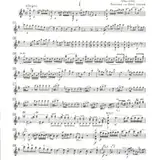
Here's the next Multitrack Session of my Score for Pastry Party. The score sheet and Midi File for this track are attached at the bottom of the post. The multitrack session is the unedited penultimate take of this track that we made.
As I mentioned already several times, I'm a big fan of musicians playing together as much as possible rather than stemming it down. One of the reasons for this is that every musician will find their role in the music way more easily if there is proper context provided.
An even bigger reason for me is that with everybody being present and playing together the musicians will feed of each other's energy. You might have noticed that in this score sheet there are a few "improvisional" lines, especially for the rhythm section which are notated with slashes and include relatively little guides of what to play exactly. For the musicians playing these parts being present in the same room playing together with all other musicians makes it way easier to adapt their playing to the context. For instance a great jazz piano player who's playing accompanying patterns will notice if their playing interfers with the frequency range of for instance the string chord pads that might be present as well and automatically adapt their playing or register accordingly.
Of course, you could record everything in stems and feed what is already recorded to the headphones of the next stem but ideally this should always be a bidirectional influence with musicians reacting on their surrounding context but also influencing their surrounding context in the way how they play.
For this particular music, there is one more important factor that speaks for having everybody play at the same time and in the same room which is the swing. Naturally, at least for classical musicians in Europe, the concept of swing is rather uncommon. They usually do have a theoretical understanding of what it is but that doesn't mean that their playing will actually have that "rolling" feeling of a properly executed swing.
As I've worked with this orchestra many times before, I knew that some of the musicans were pretty good at swinging (I specifically requested Big Band players for the brass section for this session) while others will remain quite stiff in that. My general approach to this is to not try to make the orchestra swing on its own as it will not work but providing them a proper bed to sit on and lock into will in fact create satisfying results. So having a rhythm section present in the room consisting of experienced Jazz players that would provide the underlying swing groove will make it much easier for everybody to get into this rhythmic feel. It's not even only the fact that the orchestra musicians can hear the Jazz musicians playing in the same room but also their sheer presence and body movements that the orchestra musicians were able to see helps to get the right feel into the music.
Having said that, I have to clarify here that there was one exception to my ideal recording philosophy here: The drums (and in other tracks Latin Percussion) were not present in the same room but were in a separate drum room, however playing at the same time and being fed to everybody's headphones.
I tried having them also in the orchestra room on a similar sessions a few years earlier. however the transients from the drums on EVERY microphone in the room with all the different distances of the microphones which would cause different delays of the transient reaching these microphones made it almost impossible to shape the drum sound to anything else but "muddy room", in spite of the player playing quite soft swing patterns. So in order to have the drum sound be precise and more flexible I decided to have the player in a small extra room.
When you open up the multritrack session, there are a few interesting things that you should look out for and experiment with:
Rhythm Section: There are several signals dedicated to the rhythm section which are worth exploring. Particularly looking at the score sheet and the rather freely notated patterns and how they are translated by the musicians is interesting to observe and educational to understand which notations lead to which results
Drums: As mentioned above there is a quite extensive set of microphones dedicated to the drum set which you can use to practice live drum mixing skills as well as study swing patterns.
Swing interpretation: It is interesting to listen through individual close mics to see which players were comfortable with playing swing and which felt a bit more uncomfortable.
If you have the time and desire to improve on these issues, I would recommend trying to mix that cue as it needs a different approach to embed a rhythm section into an orchestral mix than just mixing orchestra alone. Try if you can make the rhythm section tight and provide a proper fundament and place the orchestra around it without one of the two overpowering each other and still feel like they are playing together.
As always, feel free to send along any mix attempts!
So without further ado, here's the Multitrack Session:
Username: eclair
Password: eclair