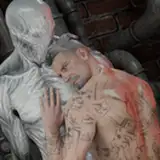
HQ 3k artwork for "Angels"~
On the moon, in the very distant future. Reborn Daneel Olivaw in Fallom's body, holding his own robot body, which is already 20 thousand years old (with constant replacement of parts).
Here is hidden (by Asimov) a deep metaphorical meaning that a person evolves into an artificial mind, then improves to a supermind, and having reached the technological limit, he becomes something mystical, divine androgyne, whose control and mind encompasses the entire galaxy and all living and nonliving in it. In fact, he becomes a deity, the creator of a new world.
***
In Foundation and Earth, the Solarians have genetically modified themselves into a distinct species from humanity — becoming hermaphroditic, superintelligent and containing biological organs capable of powering and controlling whole complexes of robots on their own.
(Three Laws of Robotics, 2007 Schools Wikipedia Selection. Related subjects: General Literature)
"A robot may not injure humanity or, through inaction, allow humanity to come to harm"—and how the imperative to protect abstract humanity moved the robot Daneel Olivaw to bring about the founding of Gaia" (346-48; ch. 101). For the continuation of Daneel's existence, and the establishment of "Galaxia" (the galaxy as mostly conscious organism), Daneel will "merge a human brain into" his own (350-52); the human he chooses is Fallom: "hermaphroditic, transductive, different"—and perhaps a new force in the galaxy.
(Asimov, Isaac. Foundation and Earth.)
"When they finally arrive at Earth and find it a radioactive wasteland, Bliss detects a brain “not human” and “not quite robotic, either” (Asimov, Foundation and Earth 477). Pelorat eagerly offers, “I would like to see that. . . . It would be exciting. Something new” (Asimov, Foundation and Earth 477). The “something new” is actually a very, very old friend: Daneel Olivaw. Still a humaniform robot, it is only Fallom who realizes from the beginning that Daneel is actually a robot thanks to its special Solarian brain. In their conversation with Daneel, they learn from him that robot brains and human brains are very similar in their inability to function when placed in high radiation: “Unfortunately, that is so, sir. Our positronic brains are as sensitive to radioactivity as human proteins are” (Asimov, Foundation and Earth 483). They also learn that Daneel, being twenty thousand years old, is now, unfortunately, dying, and this is the real reason that he has, through his machinations, persuaded them to come to Earth (and the Moon where Daneel maintains his base of operations).
Daneel explains: I can cease to exist, sir. . . . I am old. Not one sentient being in the Galaxy that was alive when I was first given consciousness is still alive today; nothing organic; nothing robotic. Even I myself lack continuity. . . . There is no physical part of my body, sir, that has escaped replacement, not only once but many times. Even my positronic brain has been replaced on five different occasions. Each time the contents of my earlier brain were etched into the newer one to the last positron. Each time, the new brain had a greater capacity and complexity than the old, so 111 that there was room for more memories, and for faster decision and action. (Asimov, Foundation and Earth 488-489)
Over the millennia, Daneel has found it necessary to replace and improve parts of his body including his brain. Daneel continues to elaborate on his present predicament with his (once again) aging brain: But. . . . The more advanced and complex the brain, the more unstable it is, and the more quickly it deteriorates. My present brain is a hundred thousand times as sensitive as my first, and has ten million times the capacity; but whereas my first brain endured for over ten thousand years, the present one is but six hundred years old and is unmistakably senescent. With every memory of twenty thousand years perfectly recorded and with a perfect recall mechanism in place, the brain is filled. There is a rapidly declining ability to reach decisions; an even more rapidly declining ability to test and influence minds at hyperspatial distances. Nor can I design a sixth brain. Further miniaturization will run against the blank wall of the uncertainty principle, and further complexity will but assure decay almost at once.” (Asimov, Foundation and Earth 488-489)
Like Moore’s Law, there will eventually be a limit to the number of transistors possible within a volume of space physical universe on the quantum scale. However, he needs to stick around a bit longer in order to help shepherd the galaxy of human inhabitants toward Galaxia. It is with that in mind that he orchestrated Trevize’s journey with Pelorat and Bliss: “Because, sir, I have been searching for a way out, and I have been carrying on in the hope that I might find one. I think I have. Instead of replacing my brain with yet another positronic one, which is impractical, I might merge it with a human brain instead; a human brain that is not affected by the Three Laws, and will not only add capacity to my brain, but add a whole new level of abilities as well. That is why I have brought you here.”
Trevize looked appalled. “You mean you plan to merge a human brain into yours? Have the human brain lose its individuality so that you can achieve a two-brain Gaia?”
“Yes, sir. It would not make me immortal, but it might enable me to live long enough to establish Galaxia.” (Asimov, Foundation and Earth 490-491)
For Daneel, Trevize is too resistant, Pelorat is too old, and Bliss is, well, too Gaia. Daneel believes that he needs an outsider, a brain unlike those of Trevize, Pelorat, and Bliss. It was for this reason that he manipulated their journey to pass through the isolationist Solaria to bring the child Fallom to him. What is left out of the story is Daneel’s mind melding fusion with a child, who otherwise could grow up to be her own person with the ability to choose whether or not she would accept this imposition. Interestingly, Trevize and the others—including Bliss—accept the arrangement. Perhaps, they are too worried about what might lie beyond the Milky Way if they do not allow Daneel this opportunity to complete the transition of everyone into Galaxia. Alternatively, they could simply be interested in what kind of brain might result from the fusion of Daneel and Fallom— another mystery to unravel.
However, Gaia and the eventual Galaxia are utopian dreams, because each assumes that every human being would desire the shared memory and imaginative power of a population. Gaia and Galaxia erase personal autonomy and privacy by their imposition on those who do not desire to be a part of either."
(BRAINS, MINDS, AND COMPUTERS IN LITERARY AND SCIENCE FICTION NEURONARRATIVES
A dissertation submitted to Kent State University in partial fulfillment of the requirements for the degree of Doctor of Philosophy. By Jason W. Ellis)
***
Fallom was a child (and a copy) of Sarton Bander, who is described in the book:
"His complexion was pale and his hair light and long. His face was grave but quite young in appearance. His bare arms and legs were not particularly muscled. The robots stepped aside for him, and he advanced till he stood in their midst. He then spoke in a clear, pleasant voice and his words, although used archaically, were in Galactic Standard, and easily understood.
He was wearing a thin white robe, draped loosely over his shoulder, with large openings for his arms. It was open in front, exposing a bare chest and loincloth below. Except for a pair of light sandals, he wore nothing else. It occurred to Trevize that he could not tell whether the Solarian was male or female. The breasts were male certainly but the chest was hairless and the thin loincloth showed no bulge of any kind."