
Reverse Pyramid Training 2.0: Does New Mean Better? (Hint: High Reps Rules) - Q&A #4
Added 2018-03-08 22:43:11 +0000 UTCThis week's question relates to The Reverse Pyramid Training Guide which you should read for any of this to make sense.
Q: Not sure I understand what you mean by the new dependent RPT set structure. In the example you gave it looks...
A: Let me stop you right there and say I screwed up on the table. Your confusion is entirely understandable, but the new table should clarify along with my explanation.
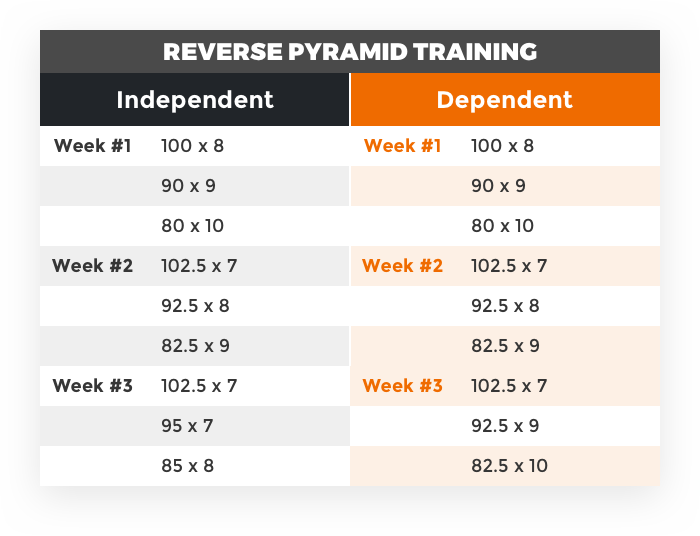
The above shows a theoretical 3-week run with a Goal of 8 using the independent and dependent system. Independent is the previous RPT system, dependent is the new one. Take a look at Week 3. In the independent system, any set where the Goal of 8 was achieved, progressed on its own i.e. sets progressed independently.
In the dependent system, all sets depend on the first set; if you hit the Goal in the first set, all following sets are increased by the same amount. It's really not that complicated. A more interesting question is whether this is better or just a trivial detail that doesn't matter in the long run. Well, this gives me an excuse to talk about that.
According to a statistical analysis I made, it actually is better. Even though outcome didn't quite reach statistical significance with a p-value of 0.011, it came close enough for me to draw my own conclusions. Especially when I take my personal experience into account. Let me explain why.
First of all, AMRAPs are best in the >8-rep range. This is because you can squeeze more out of your muscles using moderate to high reps. The easiest way to describe why is this. Let's say your capacity is 95. Now let's say you were to do 2 sets of the same movement, one where the Goal is 5, another where the Goal is 10.
In the Goal-5-set, each rep drains 20 capacity. By the 4th rep, you've spent 80 capacity, and don't have enough to do another rep. If you know what's good, you'll rack the bar now, leaving 15 capacity on the table.
In the Goal-10-set, each rep drains 10 capacity. By the 9th rep, you've spent 90 capacity, and don't have enough to do another rep. You rack the bar and leave 5 capacity on the table. That's 10 more capacity spent compared to the Goal-5-set, which means you've gotten a higher quality AMRAP.
The dependent system is a move towards slightly higher reps for all but the first set and that's good. This also allows more tangible and consistent progress in set 2 and 3, etc, because if you're constantly upping the load and losing a repetition, it becomes a zero sum game. 95 x 7 isn't any better than 92.5 x 8, but 92.5 x 9 is better than both of them. Staying at the same weight for another week and adding a repetition is often easier than increasing the load and completing the same amount of reps.
Therefore, it follows the independent system is more empowering and that's very important. You'll often find yourself stuck at the same weight for your first set, but able to add a rep to one or more of the proceeding sets.
So in week 2, you may not be able to reach your Goal, but you manage to add a rep to your third set. In week 3, you add another rep to your second set. You've been getting stronger all this time. And in the fourth week, you're strong enough add a rep to your first set, finally hitting your Goal.
All the above is besides the fact that low reps to failure can be quite punishing for your joints, especially in the pressing movements. That's another reason I'm no fan of <8-rep-AMRAPS on a weekly basis. The deadlift is an exception, but that's a topic for another day or time.
That's all for today folks. Did you like? Helpful? Let me know in the poll. Thanks to everyone who voted last time. 78.55% loved the previous Q&A making it the most appreciated Q&A thus far. Definitely a subject I'll revisit in the future.
See you in 1-2 weeks.