CreatorsOk
3blue1brown
3blue1brown

patreon


The scope creep of e and the hyperdarts puzzle

Hey everyone,

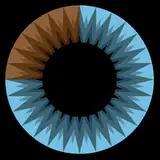
More on the animation above in just a moment.  There's no new video this month, but I thought I'd at least share some of what I'm working on.

The main project, whose writing has taken dramatically longer than I anticipated, is one likely to be titled "why e is overrated".  You may recall that in the e to the i pi in 3.14 minutes post, I mentioned wanting to pair that with another short project.  Ha!  How young and optimistic I was back then.  It would be a quick little rant, I thought, a bit of fun before moving on to more serious projects.  Pshhht.

What it's grown to, which I think is for the better, is a richer overview of what the function e^x is all about, from the first time Jacob Bernoulli started puzzling over compound interest, up to a more modern take.  In particular, a full understanding of this function requires knowing what it's all about not just when the input x is a real number or even a complex number, but also when we contemplate more exotic inputs like matrices, operators, quaternions, etc.  The case I want to put forth is that writing this function using the number e and the idea of repeated multiplication, while perhaps helpful for early examples of how it's used, quickly becomes a confusing and unrelated distraction from what's really going on.  To contrast, we run the thought experiment of what teaching all the topics related to e would look like without actually using the number e.

The pi/tau debate had it's fun, and we can all agree phi is overrated, so I think it's high time we give more scrutiny to the vaunted position e holds.  Hopefully this will be coming to a screen near you in the not-too-distant future.

Exposition-style videos always take dramatically longer to write than problem-solving videos, so last month when I was stuck on this script, I turned to the windmill IMO problem as a productive distraction, which was indeed much faster to produce.  Similarly, I recently turned to a different problem-solving one to work on in parallel, whose script took about an afternoon to write instead of two months.  I'll share the puzzle with you now for anyone who wants to try it out themselves, which I originally saw this on twitter, thanks to Greg Egan. 

The video above outlines how a certain altered game of darts works.  We're on a square 2x2 board, with a "bullseye" that starts off big enough to fill the width of the board.  If you miss the bullseye, it's game over.  If you hit it, it will shrink according to a special rule, one which rewards shots near the center, and penalizes ones near the edge.

Specifically, for a given hit, draw the line from the circle's center to that point, together with the chord of that circle passing through this point, perpendicular to that line.  The length of this chord determines the diameter of the new bullseye.  Notice in particular how that chord is short for shots near the edge, and long for shots near the center.

What's the puzzle?  Suppose a player has a uniform probability of hitting anywhere within the square.  Yes, this is contrived, but aside from being easier to model it makes the answer to the following question extremely beautiful: What's the expected number of bullseyes this player gets?

-Grant

The scope creep of e and the hyperdarts puzzle

Comments

I was busy grading tests but now I've officially been nerd sniped (https://xkcd.com/356/) - off to write a simulation about this...

Well...I've had to take a couple weeks off, so I wouldn't say it's close. Hang tight!

3blue1brown

Wonderful!

3blue1brown

I just joined the community and could not be more excited about this video coming out.

Still looking forward to this video Grant. Is it close!?

Jacob Mirra

To me it looks like PI/e...let's see until grant lifts the curtain...

I had exp(pi/4) in my answer as well. I might have had pi/4 * exp(pi/4), but that might have been a failure to normalize somewhere.

Jacob Mirra

Hi Jonathan, Yes! I probably won't go into the Lie algebra context (though we'll see!). Thanks for the link to the Poincaré writing, I'll look into it.

3blue1brown

Grant, I'm super excited to hear that you are taking on the challenge of addressing "what the function e^x is all about." I'm certain you know that this goes to the heart of Lie theory (and thereby huge swaths of quantum mechanics) when x is defined over the basis of a local Lie algebra (and more broadly to Riemannian manifolds even when it is not, which Cartan explored at length). However, if you're scrutinizing "the vaunted position e holds", it might be of some interest that, according to Poincare, Lie himself was concerned that in his researches he had artificially restricted himself "to the study of continuous groups..., to which the rules of ordinary infinitesimal analysis apply." Poincare goes on to say, "I do not know whether any trace of this thought would be found in his printed works, but in his correspondence, or in his conversation, he constantly expressed this same concern." (source: https://projecteuclid.org/euclid.bams/1183417670 , page 21).

I get exp(𝛑/4). The inverse symbolic calculator (http://wayback.cecm.sfu.ca/projects/ISC/ISCmain.html) gave me the hint I needed to see the light.

[Edit: deleted my comment to avoid spoilers.]

Jacob Mirra

Worked on this for ~2.5 hours. Approached it one way and got sqrt(e), and another way and got 2. Both solutions are probably wrong (probability is not my strong suit), but I'm glad to have spent some time with it before the video dropped. Keep up all the great work, Grant. This will give us a hint at what the probability series might have looked like. Also, I really liked the intro animation/thumbnail animation for the windmill video.

Oh wait it also involves integrals... Because function continuously changes within bullseye...

Timur Sultanov

Is it an expectation calculation problem? Doesn't seem too hard except for all pi*r^2 everywhere

Timur Sultanov

Amazing This is a very nice question

Thanks for the challenge. It's definitely got me thinking!

Programmable Spacecraft

You're spot on, the relevance to the DE series was actually the motivation for the whole project to begin with.

3blue1brown

Thanks! I had a little exposure to exp in the context of lie algebras, which really does feel powerful, but I'm sure less exposure than you :)

3blue1brown

Good question. It is in a square board, with the probability of one being pi/4. It may seem ugly at first, but I promise the final answer is extremely beautiful. Also, in getting to the answer, you'll see why I'm using the prefix "hyper" in the problem title ;)

3blue1brown

Grant, have you double-checked that this problem isn't simply a circular board, where the probability of the first bullseye is 1? The calculations seem ugly (and to involve tau) if you throw onto a square, though I haven't checked the details.

Jacob Mirra

They throw until they fail.

Jacob Mirra

The number of bulls-eyes they get depends on the number of throws they get. Are you assuming unlimited throws? 3 throws?

Neal McBurnett

Ooh nice. I recall coming across a similar game problem where the expected value comes out to e, and it was all the way back in high school. I could be mistaken, but I think it was roughly as simple as picking a number uniform-randomly in [0,1] and adding it to your sum, and game over when you hit 1. Dart board is maybe a little more visual. But I wonder if you could get any mileage from making analogies to similar discrete problems like "roll a die until your sum is X". I'm quite sure you could show that expected value approaches e as the numbers grow appropriately... but good lord, don't change the script now, I'm sure it's great. Totally agree. e is simply exp(1), it's the function that matters, not its value at 1. I think my favorite exponential function is that from a Lie Algebra (a vector field) to the manifold. (LaTeX: $ exp: \fraktur{g} \rightarrow G $). You ever have the opportunity to study those, Grant? I wouldn't think undergrads often do, even at Stanford. Another thought just occurred to me, a world with "Triangle of Power" as well as "exp" and "log" notation only for the natural exponential and natural logarithm, would be a truly wonderful world to live in.... at least from a math education standpoint, lol. Glad you decided to put in the time to make this. Can't wait.

Jacob Mirra

Well, now you must hire a team and develop a VR/AR version of this game. Also, partially related, would love if you'd somehow link this to the DE series (specifically solving using matrix exponents and JNF).

I honestly don't remember what life was even like before 3b1b, or what we did for fun, or how we kicked back to relax and let the rest of life's problems dissolve into background radiation as we are drawn completely and utterly into whatever fascinating subject Grant explores this time. I've been keeping my fingers crossed for an e video! Super stoked!


More Models and Creators